
Digital Education Network empowers staff with their digital practice

At Leeds, collaboration and curiosity are at the heart of digital innovation.
The Digital Education Network (DEN), an institution‑wide Community of Practice, brings staff together to explore emerging ideas, share best practice and experiment with new technologies shaping the future of education. Through its monthly meetings, colleagues from across the University connect to discuss their latest projects, covering everything from online learning and assessment to digital skills and emerging tools.
This month’s Digital Education Network meeting focused on how AI and digital capabilities are transforming learning, teaching and professional practice across the University. Read on to discover key ideas and updates from this month’s session.
Students reflect: Is AI breaking or making the academic space?
Artificial Intelligence is reshaping ways of working across disciplines and sectors. This rapid pace of change is transforming how students learn, and to understand this further, the Academic Activities Executive at Leeds University Union collaborated with University societies to create ‘Leeds AI Week’.
This student‑led initiative encouraged discussion about the AI tools students currently use, future developments, available support and how AI can boost employability.
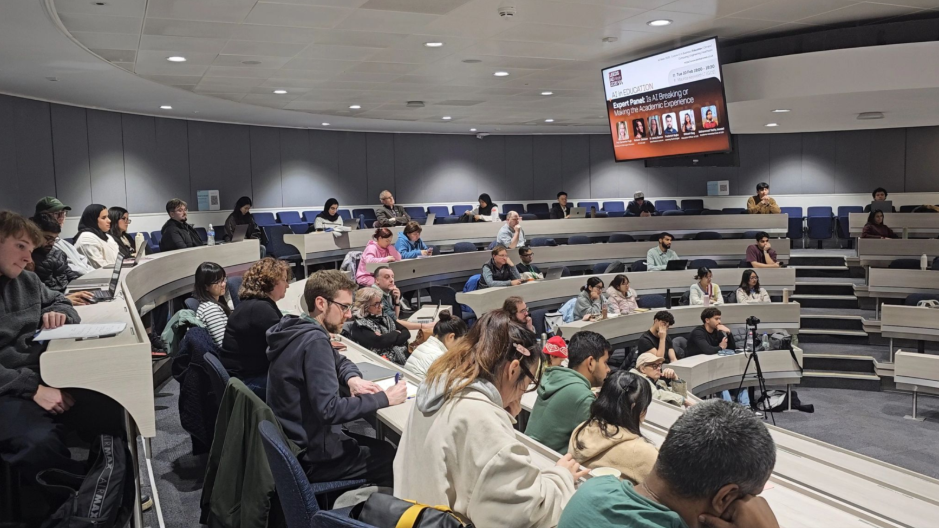
The event received positive feedback from students, with 78% of attendees reporting increased confidence in AI, and onene student noted that the week improved their understanding of AI’s real‑world applications.
During the Digital Education Network meeting, Mohammad Tasfiq Jawaad, Student Chair of Leeds AI Week, shared an inside look at the event. DEN attendees were particularly interested in his proposal for student‑led, accredited events that recognise participants’ ongoing development and their engagement with their degree or the industry they hope to enter.
Visit the Leeds AI Week 2026 website for more information on the agenda and speakers for the event.
Making change happen through Digital Champions
Ann-Marie Hartland (Director of Engagement for IT), Sue Cunningham (IT Communications Manager) and Naomi Tickhill (Head of IT for Corporate Services) joined the session to present their ‘Digital Champions’ programme. This exciting initiative is a year long programme that supports staff to explore Microsoft 365 and how it can help them in their working practices. Alongside developing technical capabilities, the programme is cultivating a community of peer mentors and digital advocates, which is enabling colleagues to improve their digital skills and facilitating cultural change across academic and professional staff.
The programme has over 300 volunteer sign-ups, and success will be measured using Microsoft’s adoption scores, which will track how effectively the University uses M365 tools for communication, meetings and teamwork.
While the Digital Champions initiative is limited to University staff, Digital Education Network members can enhance similar skills through the online Continuing Professional Development (CPD) courses, which cover a broad mix of digital and professional skills.
A case study about improving case studies
The University’s AI Hub is a digital platform, created for colleagues to collaborate, experiment, and discuss artificial intelligence. It showcases real-world applications and use cases that are transforming how staff work, learn and connect in the education sector.
Due to the nature of the topic, the Hub requires consistent and scalable case studies to support the University’s generative AI training. However, manually writing these case studies proved to be a long process for contributors. To address this, the Faculty of Business opted to reframe the process. Instead of asking staff to write case studies from scratch, contributors are now invited to participate in guided conversations supported by AI. Using structured templates, discussions are recorded in Teams and Copilot generates transcripts from the recordings. This shift in focus from writing to conversation has significantly improved both the speed and authenticity of case studies.
At the DEN meeting, Freddie Bujko (Learning Technologist in Digital Education Enhancement at the Faculty of Business) presented a conversation‑based workflow that has now been shared with and adopted by the Digital Education Enhancement teams. The team has created templates, guidance and workflow documentation to enable other faculties to implement the same standardised model across their own areas.
These initiatives reflect a shared commitment to exploring how digital tools can enhance teaching, improve services and empower both staff and students. From student‑driven conversations about the future of AI, to institution‑wide efforts to build digital confidence, Leeds continues to evolve the Digital Education with collaboration at its core.