
The Secret Life of Students Conference
'The Secret Life of Students' is an annual conference programmed by WonkHE, a Higher Education-focused organisation which brings together students, educators, policy makers, and industry experts to discuss current issues faced by the sector.
In this blog, University of Leeds Faculty Digital Education Managers Catherine Wilkinson and Sean Gledhill offer a collaborative reflection on the event, outlining the key themes from a day of authentic student testimonies and engaging panel discussions.
As Jim Dickinson, Associate Editor at Wonkhe, took to the stage, the ink was barely dry on the research report he had co-authored, Trained to stop learning? How students are experiencing assessment and learning in an age of AI. In his keynote, Dickinson careered through the report’s fifteen findings, gleaned from two months of focus groups and a survey of 1,055 students from 52 HE providers across the UK.
Through his research and the day’s events, some key themes emerged to us which we outline below as being crucial to how we understand AI use, design learning and assessment, support students and staff, and prepare students for a world filled with uncertainty.
We need to acknowledge that some issues have always been here
…with university resources stretched to their limits, we are in need of more support for students at “unsociable” hours. And you're probably thinking “we’ve got guidance for that” – the document you’re referring to is probably a 30 page policy, buried somewhere on the university webpage. No one has time for reading a policy when all you need is a simple yes or no.
Bethany Jackson (Vice President Education and Welfare, Bucks SU)
The growth of AI is, as Josh Fleming from the Office for Students (OfS) remarked, “simply supercharging risks that already existed”. This includes poorly designed assessment, inadequate provision of well-structured peer learning, time poverty, insufficient support for students and a system which rewards outputs over thinking and a lack of opportunity for students to account for their learning.

We need to learn the multitude of ways students use AI
Grammarly fixed spelling but couldn’t help me deliver that perfect sentence. Glean helped me process lectures. Extenuating circumstances gave me breathing space. But ChatGPT did something none of them ever had: it helped me understand. It slowed academic language down to a pace my brain could breathe in. It let me ask the same question ten different ways. It turned my scattered thoughts into something structured. For the first time in education, I didn’t feel behind. I felt level.
Lee-Ann Durrant (President of Education, University of Suffolk Students' Union)
To help us understand what we need to change, we need to understand the ways that students use AI. On the day we heard from students who use AI as an ‘always on’ tutor who responds far quicker than university staff, and a ‘study buddy’ who compensates for the absence of a social network or the time to engage with peers. We also heard a powerful testimonial from a mature student with ADHD and dyslexia about how AI is, as a mature student juggling her disabilities with caring and work responsibilities, her “most reasonable adjustment” when the university offers her the one commodity she simply doesn’t have – extra time. The Student Stories we heard throughout the day highlighted that AI can no longer be thought of purely as a tool to accelerate the production of an output.

We need to enable students to engage with AI equitably and confidently
In my final year, a teacher told us that despite our essay being AI-supported, she would be “disappointed” in the class if they used AI because we should be “using our brains."
Gemma Veal (Societies and Employability Officer, Exeter Students’ Guild)
The message was repeated throughout the day that blanket AI policies are creating unnecessary anxiety and hesitance in students, stopping some from using a tool they will be expected to use in the workplace. One testimonial from a current student articulated how a peer was being actively encouraged to use AI on their work placement which freed them up “to think creatively, to think creatively and to do the human part of their job”. She went on to state that students need clear guidance on AI and “to be equipped with the knowledge to engage critically on AI as a topic” because, right now, she is one of many students who “are left to figure it out alone – caught between the fear of being penalised and the fear of being left behind”.
These issues can exacerbate inequalities such as the shadow AI university and, as surfaced in Dickinson’s research, that female students are less likely to use AI due to anxiety of being penalised. We have a responsibility to rethink how learning and teaching can be redesigned to enable students to develop the skills they are likely to need in a way which reduces such inequalities.

We need to work with the right partners to design accountability moments
We are gaining nothing by being divided on how students should be using AI and a lack of clear guidance and fear mongering is preventing students from being able to freely engage in the discourse.
Gemma Veal (Societies and Employability Officer, Exeter Students’ Guild)
We heard that only a minority of students believe their assessments reward thinking and reasoning rather than production and compliance – we need to design assessments which focus on process visibility in terms of AI, rather than just outputs. We need to ask ourselves, ‘what is assessment for?’, and trust in students to co-design authentic accountability moments that will result in them being supported to engage with AI to test, interrogate and deepen their understanding,
When looking for the right accountability moments in assessment, there is a danger that a move back to large exam halls is identified as the perfect solution. Universities need to think beyond that and partner with students to design authentic assessment that reflects post-graduation expectations, pulling focus on the process of developing assessments rather than just outputs.

We need to consider what skills employers want our graduates to have
But if AI becomes an expected digital literacy skill, there’s some serious knowledge and skill gaps for students when they are applying for and entering the workplace. Students care deeply about employability in a turbulent job market, so should universities. And AI skills need to be part of that core offer for those who want to explore them.
Gemma Veal (Societies and Employability Officer, Exeter Students’ Guild)
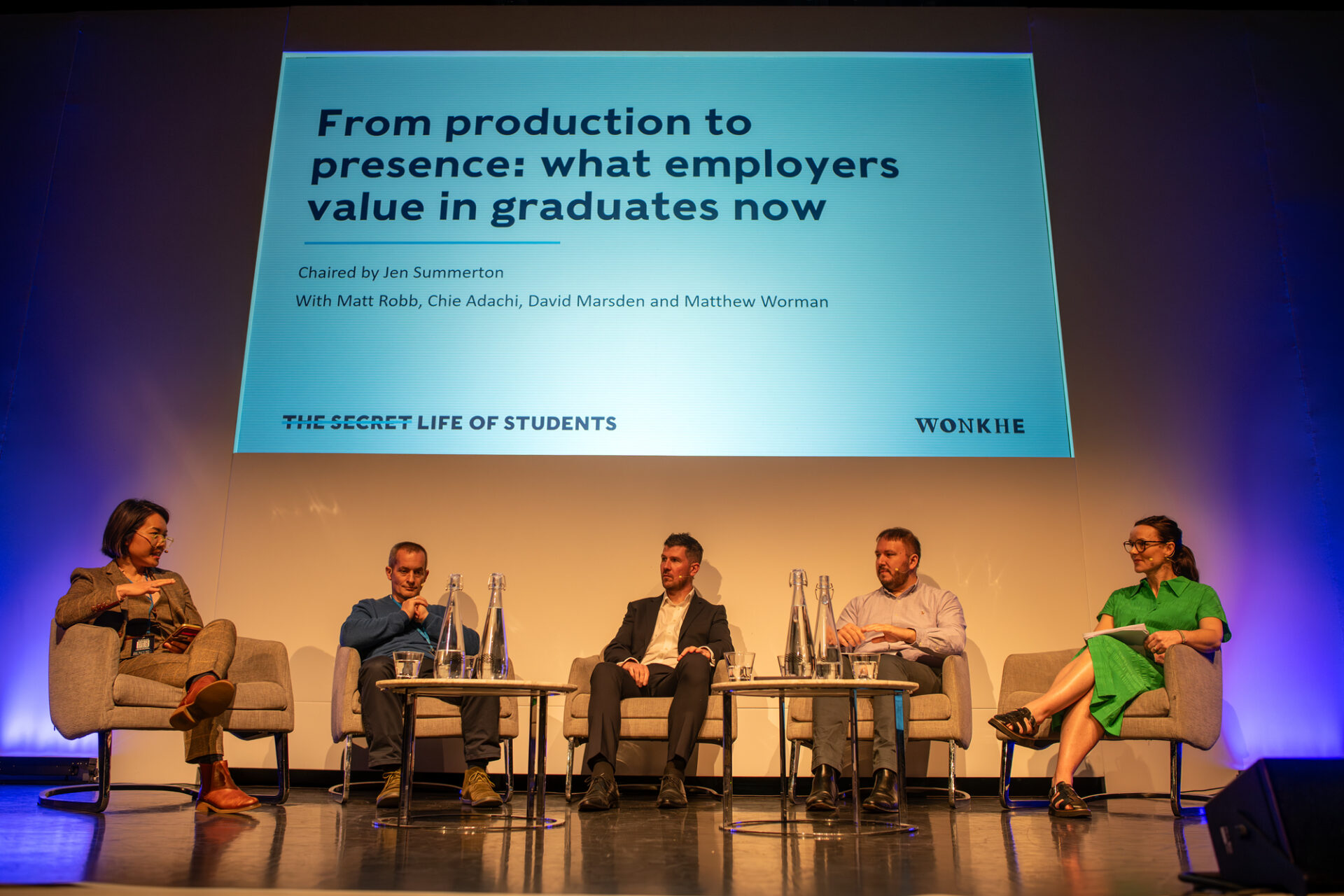
We heard how large graduate recruiters (Lloyds and KPMG) are embracing AI and equipping their colleagues to use AI to automate processes and create space for higher order human-centric skills, blending human judgement with AI insight and using that to their advantage rather than as a crutch. Representatives from those companies explained how employers are looking for skills such as a digital first mindset, critical thinking, collaboration, creativity, resilience and communication. It was made abundantly clear, however, that communication included “communication with both humans and machines”.
This points back to the need for universities to scaffold students’ use of AI through the thoughtful embedding of AI literacies into the curriculum via design of authentic learning and assessment. When doing so universities need to channel the energy demonstrated by Deborah Longworth, PVC University of Birmingham, when talking about their curriculum development journey – “we need to live it, not laminate it”. Being authentic about how we embed AI literacies into the curriculum will help to develop work-ready graduates, giving them the learning agility and curiosity that employers need in a professional landscape which will continue to evolve.
The time to act is now
We can’t afford to wait until the need is undeniable because by then, the damage will already be done
Mark Peace (Academic Director, King’s Experience, King's College London)
Mark Peace’s powerful closing reflection evoked the story of George Mellor and the Luddites to highlight how universities stand at a pivotal moment as AI begins to automate the foundational tasks that traditionally define early graduate work. Peace articulated that just as industrialisation reshaped society and gave rise to modern higher education, AI is disrupting the assumptions on which universities were built. He went on to insist that the sector must move beyond treating AI as a cheating problem and instead rethink curricula, pedagogy, and the value of human judgment. Peace closed a stimulating day by articulating how universities have a responsibility and opportunity to help students reposition their uniquely human capabilities, shaping a fairer transition than past disruptions and redefining what higher education is for in an AI-driven world.
Continue the conversation
The resources linked below offer a rich evidence base and powerful student perspectives for anyone wanting to go deeper into how AI is reshaping learning, assessment and student support. We encourage colleagues to explore these materials and reflect on what they mean for their own educational practice.
This conversation is already underway at Leeds through our AI Steering group and connected working groups, where colleagues are exploring how we support staff and students to use AI thoughtfully. Please continue the conversation on the AI hub and let us know what resonates with you.
Core research
Trained to stop learning
- Full research report exploring how students experience learning, assessment and support in the current higher education system.
Key findings
- Concise slide deck pulling together the report’s headline messages.
Additional analysis (appendix)
- Further details from the research team, with particular attention to student support and equity.
Student stories
- Transcripts and narratives referenced in the research, offering richer qualitative context and bringing the findings to life.
Part of a wider conversation
These pieces provide useful context for how the research connects to ongoing debates about AI, assessment and institutional responsibility published via Wonkhe.
- The shadow university: who gets an AI‑enabled education?
- An accountability moment is what makes AI work for learning
- AI hasn’t broken assessment – it’s exposed what we were already ignoring
- Building an AI manifesto
- Educating the AI generation
Academic misconduct
- A collection of example academic misconduct cases used to provoke conversation and illustrate some of the mixed practices students are facing.
- Office of the Independent Adjudicator: AI and academic misconduct an OIA casework note and set of case summaries examining student complaints related to the use of AI in assessment, with a focus on fairness, evidence and institutional process.